
A Curfew, a Steam Oven, and a Pinch of Yeast: How the Baguette Was Born
Oct 21, 2026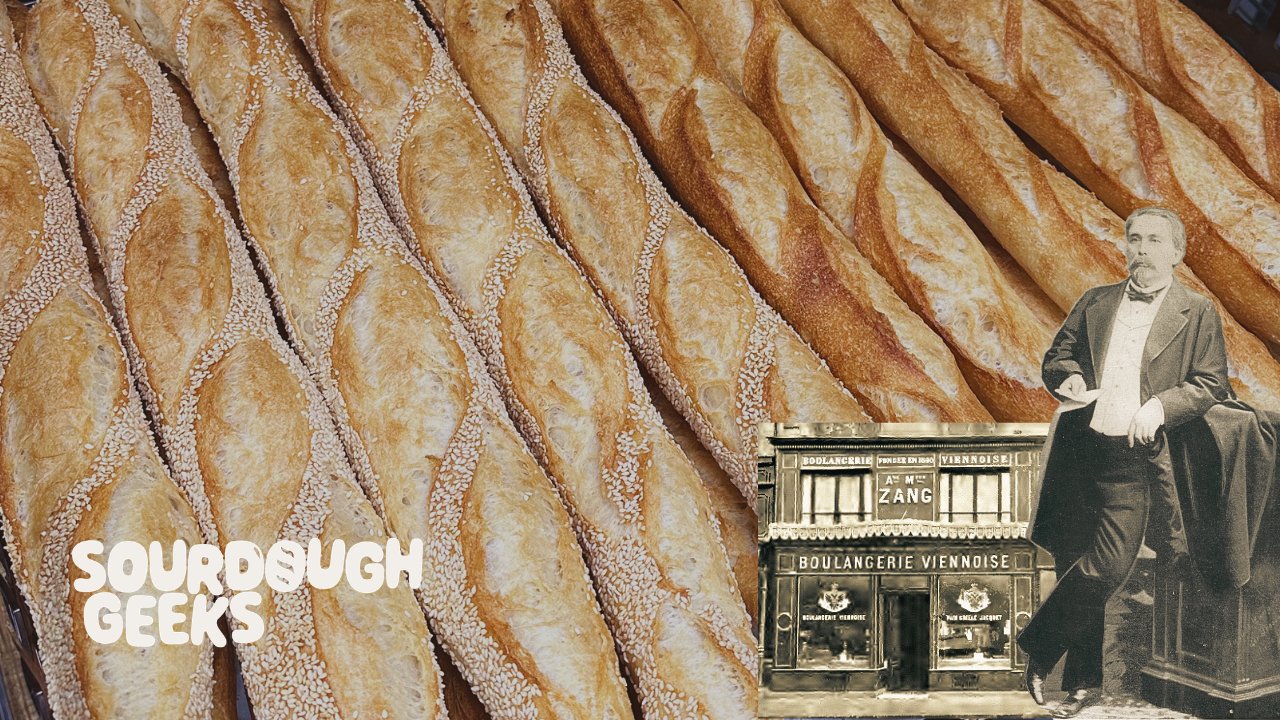
From Crisis to Tradition
As James likes to point out, the baguette is a global icon with its own emoji 🥖, which is more than sourdough can say. For a bread that seems as old as France itself, it is surprisingly young: the baguette as we know it is only about a hundred years old. It was born from a labor dispute, shaped by steam and commercial yeast, and is now protected by law. This is the story James told at a recent BREAD Talk, and how the poolish method used in our Baguettalong fits into it.
A Protected Loaf
In 1993, France passed a bread decree to protect artisan bakeries from industrial supermarket clones. A baguette de tradition française may contain only wheat flour, water, salt, and yeast, levain, or both, and freezing the dough or adding chemical preservatives is banned. Three natural additions are allowed in tiny amounts: malted wheat flour up to 0.3%, fava bean flour up to 2%, and soy flour up to 0.5%. As James explained, French mills add these to keep flour consistent from harvest to harvest, with malt adjusting the falling number and fava or soy acting as a dough conditioner. The same decree lets bread with up to 0.2% baker's yeast be sold as pain au levain. The reasoning, as master baker Jeffrey Hamelman explained it to James, is that some regions of France have long cold spells, and a pinch of yeast lets bakeries there offer naturally leavened bread all year round. James has firm views on it all the same: "I've done a lot of hybrid doughs, but I call them that," he says, because otherwise adding the yeast is "a little bit of a cheat code." Modern French law makes room for sourdough. The original baguette, however, was a step away from it.
Before the Baguette
In 19th-century France, nearly every loaf was made with multi-stage sourdough ferments. "Baguette" meant a stick, a wand, or any long, thin object, but not bread. The loaf of the day was la miche, a large, heavy round of naturally leavened bread made from coarse stone-ground flour. Having it ready by dawn meant what James calls "crazy overnight shifts" for bakers. (A word of warning: one round loaf is une miche, but in modern French slang les miches are buns of an entirely different kind.)
Steam Arrives From Vienna
In 1839, Austrian baker August Zang opened the Boulangerie Viennoise in Paris and brought the steam oven to France. Steam, in James's words, "completely changed what was possible" in bread production, improving the rise and the crust. Zang's methods laid the foundation for the yeasted pain viennois, the ancestor of the baguette shape. For more on what steam does for your bread, read our article Steam Under Pressure: The Most Underrated Ingredient in Your Sourdough.
The Night-Baking Ban
After years of pressure from workers, a 1919 law banned French bakers from working between 10pm and 4am. With those hours gone, there was no way to have a sourdough miche ready for breakfast. Bakers knew two things: commercial yeast works faster than levain, and long, thin loaves bake faster than big rounds. Long loaves already existed, but the ban made them the daily bread, and by 1920 "baguette" meant bread. Those early baguettes contained no sourdough at all. Industrial roller milling had made soft, white flour affordable, and Parisians turned away from the sour, heavy miche toward the lighter, creamier, purer flavor of the yeasted baguette.
Poolish: Flavor on a Deadline
The origins of poolish are, as James puts it, "a little bit murky." Most accounts credit Polish bakers with bringing the method to France, which is where the name comes from. A poolish is equal parts flour and water, the same proportions as a 100% hydration sourdough starter, with a tiny pinch of commercial yeast. It ferments ahead of time, the way you would build a levain, and goes into the final dough at mix with a little more yeast. The key point: the yeast in a poolish is not there to raise the bread. Its job is to generate acids and enzyme activity that improve the aroma and give the crumb a creamy, custardy texture, while the final dough keeps the speed of commercial yeast.
Our Baguettalong Method: Poolish Meets the Tub
Today, artisan bakeries around the world pair a poolish with an overnight bulk retard en bac, in the tub. With sourdough, we usually shape first and then retard. Here, the dough gets a short rest at room temperature (pointage en bac) and the whole tub goes into the fridge overnight. The cold slows the yeast, but enzymes keep breaking down starches and building flavor. Like most overnight retards, it started as a workflow solution. The timeline is simple: make the poolish in the morning, mix the dough that evening, refrigerate it after about an hour and a half, then shape, proof, and bake the next morning. That is roughly an hour to an hour and a half of hands-on time, in under 24 hours, for fresh baguettes by lunch.
This was the method James and his team settled on at Haymarket, where fresh baguettes had to reach the store by 11am for the lunch crowd and again in the afternoon for people heading home from work. A few lessons from his time there: give the tub plenty of headspace, because if the dough pops the lid it dries out and is ruined. Cut away any skin that forms in bulk retard. And bake the next morning, because with commercial yeast, "once it's done, it's done." Then eat your baguette within a couple of hours of baking, ideally in a park with some butter, ham, and cheese, the French way.
Bakers Club members can find the full Baguettalong recipe and the recordings of both the bakealong and the BREAD Talk on this topic in their member Library. If you'd like to bake along with us next time, and bring your questions to BREAD Talk twice a month, join us here. 🌾
🤓 LOOKING TO LEVEL UP & BAKE BETTER BREAD? ✅
Join Sourdough Geeks' Bakers Club and unlock the good stuff! Resources, events, and connection, all within a private space. It's right there waiting for you!
