
Hands In! How to Develop Sourdough Dough Without a Mixer
May 23, 2026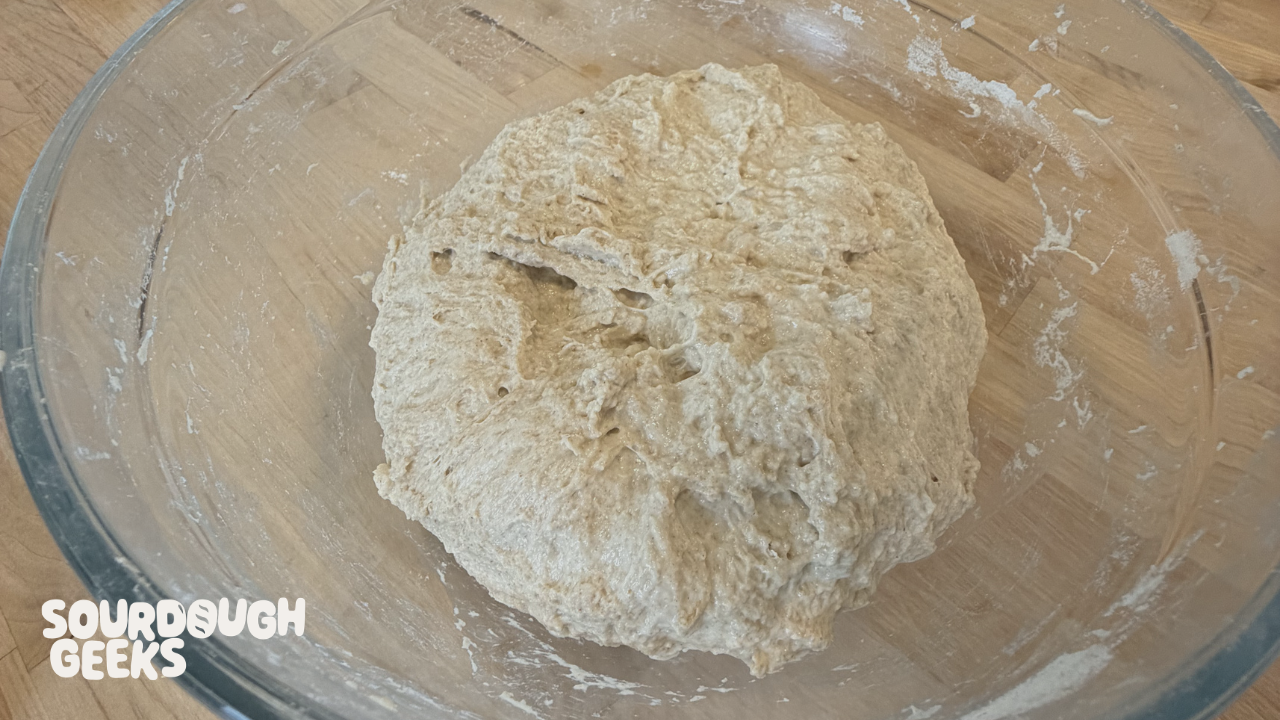
A deep dive into hand mixing, gluten development, and why every baker should mix by hand at some stage — ideally early on.
You don't need a mixer to make exceptional sourdough bread. In fact, if you're just starting out, you probably shouldn't use one even if you have one. Machine mixing offers ease, convenience, and scale — but it puts a motor between you and the most important education in baking: learning to read and understand your dough.
To my mind, mixing isn't a step. It's a continuum that never really stops. And there is no better classroom than your own hands.
The Stages of Sourdough Aren't as Separate as They Look
Every sourdough guide walks you through the same flowchart: pre-ferment → mix → bulk → shape → proof → bake. Neat, linear, discrete. The problem is that's not always entirely accurate — especially when you're mixing by hand.
When you mix by hand, the mix stage bleeds into bulk fermentation, and bulk fermentation finishes the mix. Every time you touch the dough — every stretch, every fold — you're performing a mixing event. "Bulk fermentation with folds" and "mixing well into bulk" are two descriptions of the same process. Understanding that isn't just useful — it's liberating.
What's Happening in the Dough From the Moment Water Hits Flour
As soon as water meets flour, a cascade of activity begins — and it doesn't stop until your loaf goes in the oven.
Gluten network formation. Two proteins in flour — glutenin and gliadin — activate when hydrated. Together they form gluten. As you mix and work the dough, oxygen is incorporated, which triggers the formation of disulfide bonds: covalent bonds between sulfur atoms that cross-link the gluten strands into a strong, organized network. Think of it like a tennis racket. Shear force from mixing aligns the strings in one direction; disulfide bonds form the cross-links in the other. The result is a cohesive, three-dimensional mesh.
Enzymatic activity. Amylases get to work immediately, breaking starches into fermentable sugars. Proteases — the ones that will give your dough that silky, supple feel by the end of bulk — begin modifying protein chains from the very first minute. Early on, protease enzymes are your friends: they condition the dough, soften it, and make it more extensible. Later, if you push too far, they become the thing that dismantles what you've built.
Nucleation sites for CO₂. The oxygen you're incorporating during mixing isn't just for disulfide bonding. It also creates tiny nucleation sites throughout the dough — the future locations of every bubble in your crumb. You're literally scaffolding your bread's interior structure before fermentation has properly begun.
Temperature governs everything. Warmer dough means faster enzymatic activity: more fermentable sugars, more gluten breakdown, softer dough. Cooler dough slows all of that down. This is why final dough temperature (FDT) matters so much — and why it refers to the temperature at the end of mix, not the end of bulk. You're trying to enter bulk fermentation at a known, consistent temperature so everything that follows is predictable.
Now Add Force: Hands, Machines — It's All Mechanical Development
Mechanical development — the force you apply to dough — does two things. First, shear force aligns the glutenin subunits into long parallel chains. Then disulfide bonds cross-link those chains. The network goes from random, tangled protein coils to an organized, elastic mesh.
Mixing shifts dough toward elasticity (the snap-back quality associated with glutenin) and away from extensibility (the stretch quality associated with gliadin). Rest periods reverse some of that — they allow the gluten to relax, recovering extensibility. This is why the timing and spacing of your work and rest periods matters, not just the total amount of either.
- Too little mechanical development: a weak, incoherent network — a slack dough that won't hold shape.
- Too much: over-oxidized, too tight, tears when you try to stretch it, and eventually the alignment itself begins to break down.
The good news about hand mixing is that you're rarely going to over-develop a dough the way a high-friction planetary mixer can. But it can happen, and when it does, the fix is simple: stop. Rest the dough for a few minutes. Then carry on. The bonds will begin to rebuild.
The Windowpane Test: What It Tells You (and What It Doesn't)
The windowpane test is a useful visual indicator of gluten network strength, not a magic verdict. Let the dough rest for a few minutes after your last set of folds, or mixing (don't test it immediately — the gluten will be too tight and it'll tear). Take hold of a small piece of the dough, then gently stretch it. If it thins out to near-translucency without tearing, you've got a well-developed network.
What the windowpane doesn't tell you: anything about fermentation. A dough that passes the windowpane at the end of mix may not pass it again after hours of bulk. And a dough that didn't pass it at the end of mix very well may pass it later, as fermentation does its work.
The Machines Approximated Us — Not the Other Way Around
Here's a thought worth sitting with: hand techniques aren't approximations of machine mixing. The machines were built to approximate what bakers were already doing by hand.
- Spiral mixer (like an Ooni): low friction, directional pull — organizes the network efficiently and generates relatively little heat.
- Planetary mixer (like a KitchenAid): high friction, aggressive shear — develops dough fast but runs the risk of over-oxidation and heat build-up with extended mixing.
- Diving arm or fork mixer (like a Miss Baker): most closely mimics hand technique — lowest friction, least heat, maximum extensibility.
If you're using a spiral mixer and your dough comes out feeling like "tough play-doh" with none of the bubbly, jiggly quality you get from hand mixing, there's a simple explanation: machine mixing produces a more fully developed, more elastic dough than most of us are used to. The answer is usually to pull the dough a little earlier (before it fully cleans the bowl), add a touch more water to improve extensibility, and reduce the number of folds during bulk — because the dough is already further along than it would be after a hand mix.
The Three Mix Types and Their Hand Equivalents
The bread baking world uses three broad mixing categories, originally defined for machine mixing. Each has a direct hand equivalent:
Short mix
Minimal initial mixing — just enough to bring the dough together — followed by gluten development through a series of folds spread across bulk fermentation. Gluten builds gradually. This is the basis of every no-knead recipe you've ever seen, and it's how most people learn to make sourdough. The trade-off is that bulk fermentation needs to be longer to allow the dough to reach the same level of development.
Intensive mix
Full development upfront — thorough kneading by hand — with minimal work afterward. The network is largely built before bulk begins. By hand, this is the territory of bagel dough and brioche: lower hydration, serious effort, and a potentially significant workout. For most sourdough, it's overkill.
Improved mix
The in-between approach, and the one most applicable to everyday sourdough. A short initial combine, a period of rest, then a more focused development technique — Rubaud method, slap and fold (French fold) — followed by continued folds into bulk. This is the sweet spot for most lean, artisan bread.
None of these approaches is inherently better. They're tools, each with different trade-offs in time, effort, and outcome.
The Seesaw: Mixing and Fermentation Are Two Levers on the Same Output
Here's the insight that changes how you think about the whole process: mixing and fermentation are both inputs to the same output — a developed dough.
More mixing = less fermentation time needed to reach appropriate development. Less mixing = more fermentation time required. They sit on opposite ends of a seesaw, and you can intentionally adjust one to compensate for the other.
Practical examples: If you're approaching your target final dough temperature but your gluten isn't quite there yet, stop mixing anyway and plan for more folds during bulk. If your dough is at full development but on the cool side, keep going a little longer — you're building temperature and can shorten your bulk window accordingly. An undermixed dough isn't broken. It's just unfinished. Given the right conditions, fermentation will complete what mixing started.
Most bakers think about only one of these levers. Thinking about both gives you a much wider range of tools for course-correcting in real time.
Fermentation as the Invisible Mixer
Once bulk begins, fermentation takes over a significant portion of the development work — and it does so in a surprisingly literal way.
As CO₂ bubbles expand within the dough, they physically stretch the gluten strands from the inside out — a bunch of tiny little hands performing little stretch and folds from the inside out, distributed across every part of the dough simultaneously. Little hands kneading from the inside: that's not a metaphor, it's physics.
The acids produced during fermentation — lactic and acetic — modify the pH of the dough, which in turn affects the dynamics of disulfide bonding and protein solubility. Acidification actually strengthens the gluten network, up to a point. That point is around pH 5.0–5.3; go below it, and the same acids that were helping begin to degrade structure instead.
This is why a long-fermented dough feels so silky and supple even without heavy upfront mixing. The network has been worked from the inside out for hours. It doesn't need a machine, it needs time.
The Protease Cliff: Know When to Stop
Here's the thing about protease enzymes: they don't know when to quit. In the early stages of fermentation, they're doing useful work — cleaving long protein chains, making the dough more extensible, conditioning it toward that supple, workable texture. But they keep going. And eventually, they start dismantling the structure they helped build.
Signs you've gone over the cliff:
- Dough that won't hold its shape after shaping
- A sticky surface that gets stickier as you work with it
- Dough that sticks to the bottom of your bulk container when you turn it out, pulling long gluten threads as it peels away
- No oven spring
Protease activity is temperature- and time-dependent, which means your flour matters enormously here. Fresh-milled whole grain flours are high-enzyme and have a shorter runway before protease activity becomes a problem. A strong, refined bread flour (Bob's Red Mill Artisan Bread Flour is a good example) can absorb a lot more fermentation before it begins to collapse.
Knowing your flour's ceiling — how much mixing it can take, how long it can ferment — is what separates baker's intuition from recipe following. It comes from practice, not from data sheets. The only way to learn it is to bake with that flour, repeatedly, and pay attention.
Reading the Dough, Not the Clock
Your hands are a rheometer. Your fingertips can detect differences of a single micron. The crux of it is learning to interpret what they're telling you.
The Windowpane
Tells you about gluten network strength and extensibility. Doesn't tell you about fermentation. Rest the dough before testing.
The Jiggle Test
Give your bulk container a gentle shimmy. If the dough moves as a single unified mass — like set Jell-O — you've got a well-developed network that's supporting fermentation and ready to shape.
Fold Resistance
At the beginning of bulk, a high-hydration dough will almost immediately puddle back out after a fold. By the second or third set, it should come together more quickly and hold its shape longer. That change in resistance is information. Track it.
In lower hydration doughs or when using stronger flours, this behavior may actually be reversed. Adding water is one way to make a soft dough, and developing the gluten more is the other. Allow longer rest periods with these doughs when hand mixing, and allow fermentation to do the heavy lifting for you.
Skin Tension During Shaping
A dough that's ready to shape should be tacky but not sticky. If you take a small pinch between thumb and forefinger, it should resist gently and feel lively — not slack and floppy, not so tight it threatens to tear. If you press lightly and hear the sound of gas bubbles popping, that's another good sign of appropriate development.
When you aim for roughly 85% development coming out of mix — not perfectly translucent, but stretchy and thin without tearing — you're leaving some work for fermentation to finish, which means you're preserving a nice balance of extensibility and elasticity going into bulk. Aim for full development upfront and you'll tend toward a tighter, more uniform crumb. Leave more undone and you'll get a more open, irregular crumb — but you'll need to lean into folds and longer bulk fermentation to get there.
Why Every Baker Should Mix by Hand (At Least Early On)
There's something irreplaceable about having your hands in the dough. Not just as a technique, but as a way of learning. When you mix by hand, you feel the dough change — from a shaggy, incoherent mass to something that starts to pull together, resist, and move as a unit. You feel the difference between a dough that's tight and one that's extensible. You notice when it stops fighting you. None of that information is available to you when a machine is doing the work.
This is why mixing by hand — at least while you're learning — is so valuable. The mix continuum isn't just a concept to understand intellectually. It's something you feel your way into, fold after fold, across the whole of bulk fermentation. Your hands are gathering data the whole time. The more you bake, the better you get at reading it.
Once you understand what's happening in the dough — once that continuum makes sense in your hands, not just your head — by all means hand it over to a machine. But remember that every changed variable brings new learning. New process, new adjustments, new baselines to establish.
For something so simple, bread sure does keep us humble.
This post was inspired by the May 2026 BAKERS CLUB 'BREAD TALK': "Hands In! Dough Development Without a Mixer". Club members can find the replay in the Library when logged in.
🤓 LOOKING TO LEVEL UP & BAKE BETTER BREAD? ✅
Join Sourdough Geeks' Bakers Club and unlock the good stuff! Resources, events, and connection, all within a private space. It's right there waiting for you!
