Grain Expectations: Pioneers, Change Makers & Deception
Aug 19, 2026
GRAIN GATHERING 2026 Debrief
I went to the Grain Gathering at the WSU BreadLab not really knowing what to expect from the experience.
It was the first one in 8 years, and although I knew of the BreadLab and had heard stories of the work that had been done there, I had no tangible understanding of what that meant. No personal context of its importance to me, as a baker, or to my audience as an educator. What I got was a week that reinforced the enormity of what goes into a single loaf of bread, one we tend to grab off a shelf without a second thought.
The people who've been doing this for decades
Some of the presenters were names that I recognized. Jeffrey Hamelman is a name that needs no introduction in the world of bread, but this year marked the 50th anniversary of his arrival at the bench. Many will not know the name Richard Miscovich, or Sarah Minnick, or Andrew Heyn and Blair Marvin.
- Richard is a Department Chair and teaches artisan bread baking at Johnson & Wales in Providence, RI. He also served two terms on the board of the Bread Bakers Guild and is the author of the 2013 book, “From the Wood-Fired Oven”.
- Sarah has been a chef and restaurateur for over two decades and is behind Lovely’s Fifty Fifty in Portland, OR. Episode 6 of Chef’s Table: Pizza is devoted to her.
- Blair and Andrew are the duo behind Elmore Mountain Bread and New American Stone Mills, both singularly important in shaping what bread baking has become and can yet be. Since 2004, Elmore Mountain Bread has been making bread the way it used to be, and their journey up to now can only be described as trailblazing. Ten years ago they made the switch to only organic grain grown locally, and they developed their own stone mill so that they could mill the grain themselves. That first mill would go on to become New American Stone Mills, because it was the first American stone mill developed in over a century.
There were countless others, and attendees not presenting who have also played immense roles in getting us to today.
- Jim Williams, the founder of Seven Stars bakery in Providence, RI, then went on to found Backdoor Bread, milling and baking 100% freshly-milled whole grain bread from his garage.
- Mel Darbyshire, the head baker for Grand Central in Seattle and Portland, has been replacing commodity grain with regional wheat for years.
The panels and conversations that followed universally left me in awe of my place in all of this. The movement we find ourselves in today, where regional grain is being celebrated, didn’t just arrive at this place. It has been sown and nurtured and grown and harvested over decades by a humble lot quietly going about their business, day after day after day.
There were also many who'd shown up more recently, relatively speaking, like me - people bitten by the same bug. Looking back, I could see a transformation happening in them, just as I was experiencing my own. I sat on a panel about micro-bakeries and the regional grain economy alongside people running small operations all over the country, and later heard from a panel of organic farmers representing everything from small diversified plots to larger organic grain operations, all of them talking honestly about what it really takes, financially and physically, to grow good wheat without wrecking the ground beneath it.
Farming is a notoriously isolating existence. No coworkers to bounce ideas off, no team to help carry a bad week. And a farmer's days are dictated by things largely outside their control: a broken part, a late frost, a body that gives out before the harvest is done. Now add the isolation of standing apart from the neighbors, most of whom are still spraying, still planting GMO monoculture, still chasing yield over flavor. So now we're talking hard graft, and swimming against the current, day in, day out. They must be mad. Or unbelievably stubborn and principled in equal measure. Thank God for them. They're not doing what they do for prizes, or wealth, or fun. They're doing it for something much bigger. We bakers are a conduit, tasked with delivering the product into the hands of those who care, and sharing with others who don't yet care, why they should.
Dawn in the test plots
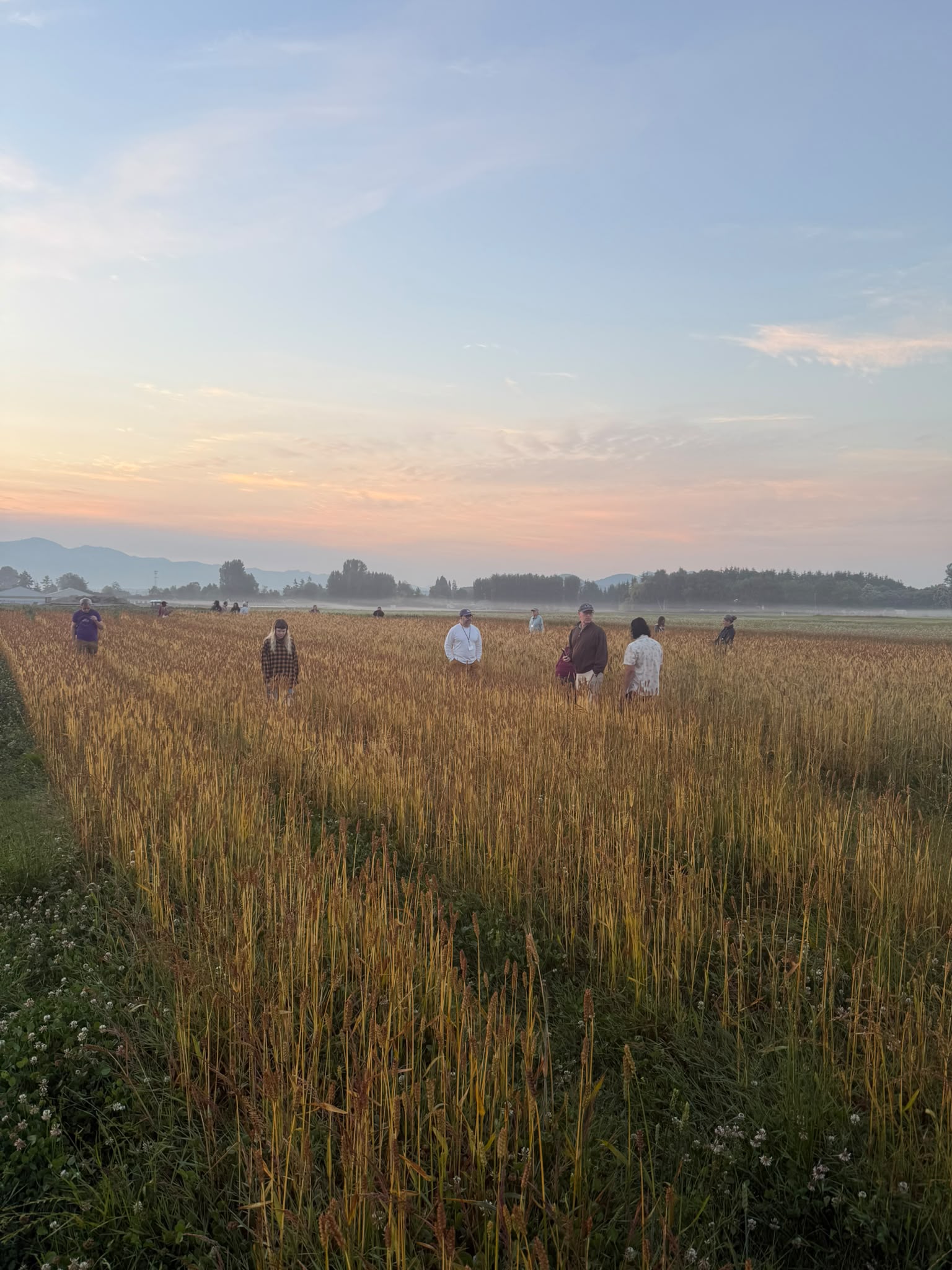
We started early on the last day, walking the BreadLab's test plots before sunrise. Mist sat low over the fields, insects and birdsong heralding the dawn, a cockerel sounding off somewhere past the tree line, and a tractor chugging across the field right as the sun came up behind it. Dr. Kevin Murphy, who runs the BreadLab now, walked us through the work happening in that field: the breeding trials, the varieties being tested for flavor and nutrition and climate resilience. The whole slow process of figuring out what a region's wheat could be, should be, instead of just accepting whatever gets shipped in from somewhere else. It's easy to talk about regional grain as an idea, but here I finally got the context of what that means in its entirety, and also what it takes to get from idea to that reality.
Baking in the field
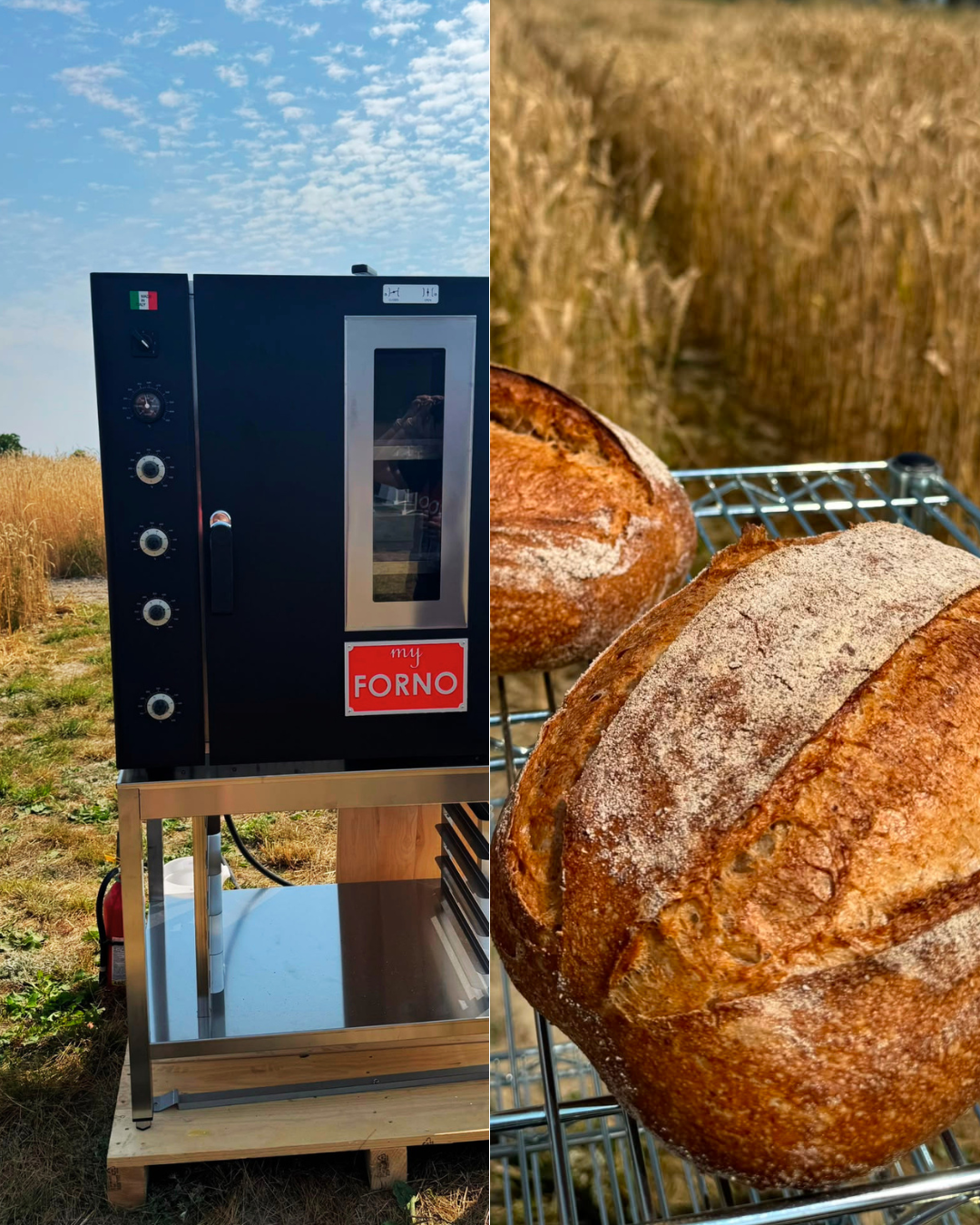
That afternoon, we baked in the same fields we'd walked at dawn. Grain from Cairnspring Mills and Chimacum Valley, including test wheats the BreadLab had spent years developing, all built into a dough that could have come from nowhere else. We baked it in the My Forno oven right there on the ground it came from, and broke the bread with everyone who'd walked those rows with us that morning. It's one thing to talk about connecting a loaf back to where it grew. It's another to actually do it, standing in the field, watching people you just met eat something that started as a seed in the soil under your feet.
Deception Pass
On the way out we stopped at Deception Pass. It connects Skagit Bay, part of Puget Sound, with the Strait of Juan de Fuca, the main outlet to the Pacific Ocean. Not exactly grain-related, but this century old state park really drove home the scale of where I sat in relation to it all. I stood on the bridge for a while, looking down at the water moving through the gap, and felt about as small as I've felt in a long time, while also filled with gratitude for the vantage point. From up there, I could take in the whole scale of the place at once, more than from anywhere else on that stretch of coast.
I mused to myself that if there were a deception, it was in thinking that being tiny and insignificant means being powerless - and just as much in thinking that any power is mine alone to claim. From where I stood, I'd never felt more capable of doing something that makes a tangible difference, as one small part of something much bigger. A we thing, not a me thing.
What I came home thinking about
The thing I keep coming back to is how much quiet, unglamorous work - decades of it - sits underneath a moment like this. Andrew and Blair, Kevin Murphy and the BreadLab team, the breeders, the soil scientists, the farmers, Hamelman, all of them have been doing this work for years, most of it without much attention, and long before the excitement we're seeing around regional grain today. A lot of people are arriving in the bread world today without any real sense of what it took to get to this point, the decades of breeding trials and failed varieties and farmers taking on risk that nobody cared much about.
And how I, as someone with an audience and some degree of influence, can help communicate that. Everybody starts somewhere, myself included. But I came home from this trip thinking hard about how I can do a better job of telling that story to the people I talk to, the ones discovering sourdough and regional grain for the first time, and how important it now is that people embrace it for not just what it is, but for what it can truly become now that it has firmly arrived as a cultural moment.
🤓 LOOKING TO LEVEL UP & BAKE BETTER BREAD? ✅
Join Sourdough Geeks' Bakers Club and unlock the good stuff! Resources, events, and connection, all within a private space. It's right there waiting for you!
