
5 Home Bakery Bread Ovens Compared - Now Expanded To 8 (2026 Update)
Feb 21, 2026
2026 Update: Comparing 8 Bread Ovens for Home, Micro-, & Cottage Bakery Set Ups
I’ve been baking sourdough for over twelve years now, professionally for around half of those, and I’ve spent a lot of time working with proper commercial deck ovens in professional kitchens.
It wasn’t all that long ago that if you wanted anything remotely close to that experience in a home, micro-bakery, or cottage setting, you had one option: a Rofco.
You could juggle Dutch ovens. You could rig open-bake hacks in a domestic oven. But if you wanted real deck baking at home, or in a ‘micro-’ space, Rofco was the only serious path.
That’s no longer true.
The explosion of cottage baking and the growth of the sourdough community created demand that manufacturers finally started responding to. Over the past few years, several new ovens have entered this space. I’ve watched it closely through Sourdough Geeks, but most importantly, I’ve now had hands-on experience with 5 out of the 6 already on the market, in real baking situations.
Back in the spring of 2023, we closed our micro-bakery, and I took a role leading the bread team at an upscale commercial artisan bakery. Over the 18 months I was there, I was in charge of R&D, worked in production daily, set up their grain program and trained newer bakers.
By April 2024, enough people were asking my opinions on cottage bakery oven options that I decided to write the original ‘5 Home Bakery Bread Ovens Compared’ article. I've revisited it once since, updating in spring 2025, and here I am again a year later to do the same.
Consequently, this isn’t just a spec comparison. This is also about what these ovens are actually like to live with day after day, and a collated source of information from my perspective as a professional baker and former bakery owner.
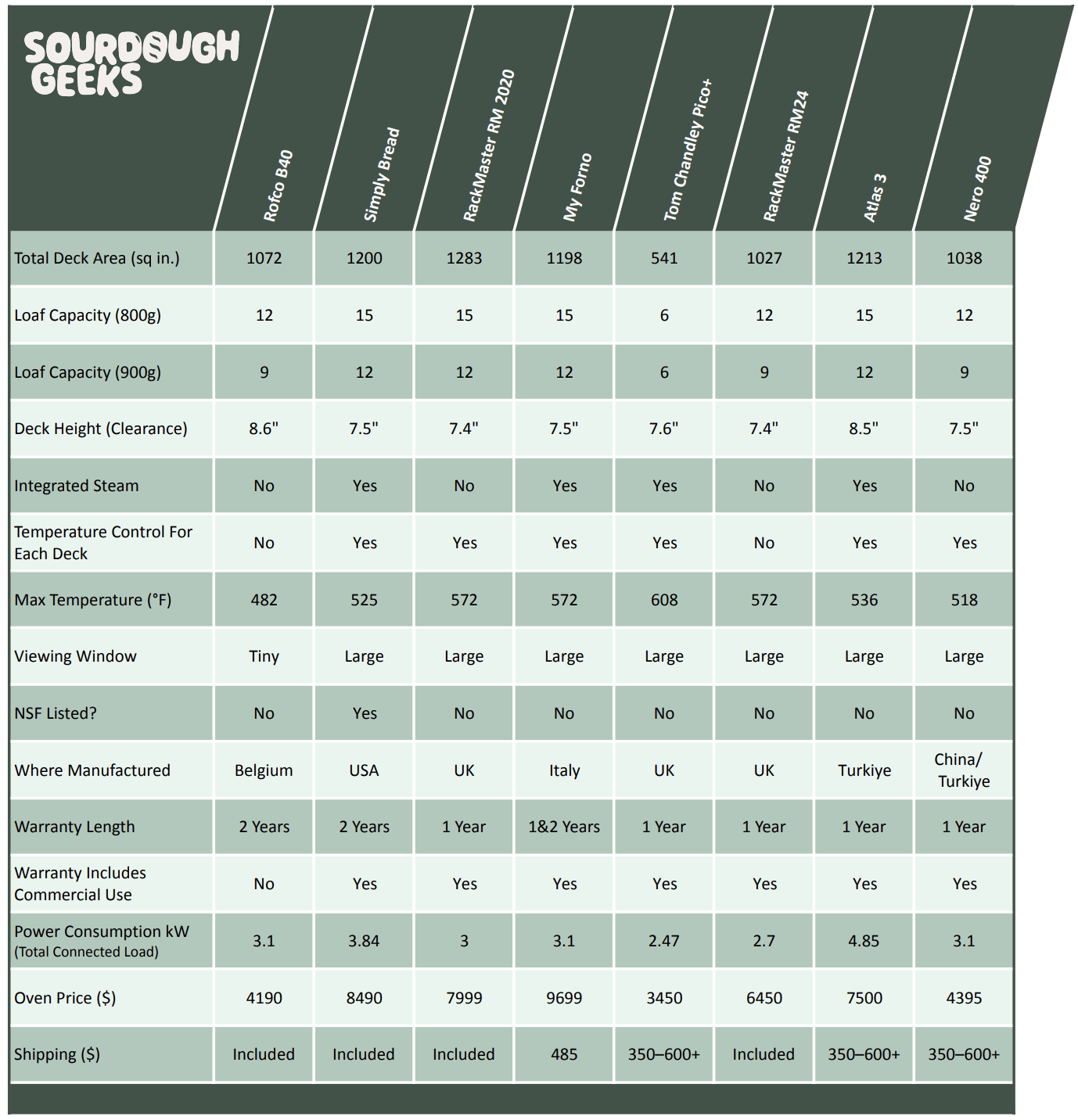
The ovens I’m covering here are:
- Rofco B40
- Simply Bread Oven
- RackMaster RM2020
- My Forno
- Tom Chandley Pico+
- RackMaster RM24
- Atlas 3 Bread Oven
Plus a sneak peek at the newly updated Nero 400, which is about to arrive in the US!
Rofco B40
This is the OG, and since Rofco was the first to market, this is a fitting place to start. I know many people who own and love their Rofco(s). There is a strong affinity for them amongst cottage bakers, partly because of the way it united them in learning to deal with its quirks and issues together. In so many ways it's a workhorse, and its simplicity is one of its greatest strengths. It doesn’t have any bells or whistles, but it also puts out loaf after loaf after loaf.
They definitely have their quirks that need adjusting to though. They have a single control for all of the heating elements, and, since they have 3 decks stacked vertically, this presents uneven heating issues. The bottom deck is notoriously the hottest on a Rofco, and is the reason for a maneuver dubbed the ‘Rofco Shuffle’ where a baker uses a peel to swap the bread on the top and bottom decks mid-bake. Yes it’s annoying, but it’s an annoyance that brought the community together.
Then there’s the door failure issues. Complaints from cottage bakers seemed to be happening with increasing frequency as the door seals would begin to fail. The doors themselves would begin to get misaligned over time and the latches that hold the door shut would also fail. An enterprising fabricator in the UK named Campbell MacFarlane actually started a cottage industry in creating fixes and workarounds for these failures (more on him later). Lots of people complained, but nothing was done to improve things by Rofco. Instead, customers were just left to sort out the issues on their own.
There are steam trays available for the Rofco, but they take up valuable real estate on each of the decks, so most Rofco owners use a garden sprayer to steam their ovens. It’s a workaround that works, but, again, it’s a workaround.
Talk to a cottage baker who has one, and you’ll almost universally hear love for it. If you hear about its shortcomings, they will likely be referred to almost romantically, and they’ll tell you about what they did to compensate for or overcome it. If you are on a strict budget then you get the most bang for your buck with a Rofco, but they will challenge your merit as a baker more than some of the more recent ovens on the market.
Simply Bread Oven
I owned and used this oven for over a year and was previously an official partner.
It produces very even bakes when dialled in correctly, has integrated steam and the customer support is excellent.
But that's where the good points stop for me. Mine was an early model and personally, I didn’t have any issues, only using it as a demo oven rather than for production. However, I did have a consulting job at a bakery that had one, and that’s where I ran into some issues that I hadn’t previously with mine.
First, adjusting the set points for an even bake is far from intuitive. A single jog dial is used to control it, and you have to click and turn and click and turn ad nauseum just to adjust it. Second, the set points are expressed as %, so you don’t really know what exactly you are changing, and you can only do it after a bake, so it becomes a game of trial and error to get it even. My oven baked evenly with a couple of adjustments, but this one never felt fully dialled in even after two weeks of tweaking settings.
My next issue was the recovery time in a production setting. In practice, I found it needed 30-45 minutes to recover from each bake to the next, and that just isn't practical if you are producing at volume.
Around this same time, I had become aware of other complaints about the door warping on the oven, so I used a level to check the door on the one at this bakery. It had only been in use for about two weeks, and the door was indeed warped. This likely caused issues with steam, temperature loss, and also an issue with water dripping out at the bottom.
By this point the number of other complaints I had heard about it were beginning to signal potential design flaws rather than just user errors or even isolated production issues. Thermostats were blowing, motherboards were getting fried, and otherwise great bakers were struggling to get usable bread from the oven.
The emergence of these problems, along with an active class action by current oven owners, mean that I do not recommend this oven.
RackMaster RM2020
This oven came from a very good place. Campbell MacFarlane saw the frustrations Rofco owners were having and set out to fix them. In many ways, he did.
The build is solid. The stone decks are thick and stable. The door seal mechanism is excellent.
I’ve now used this oven extensively teaching at Bread Camp, so I’ve had the chance to really live with it.
Two things consistently stand out to me.
The first is steam. I use a garden sprayer, which works, but the bottom deck never seems to receive the same level of steam saturation as the top. You can get good results, but you are working around the oven rather than the oven working with you.
The second is preheat time. Those thick stones take a long time to saturate — often well over two hours before the oven is truly ready for a full load. That’s fine in a commercial setting where the oven stays on all day. In a home or cottage setting, that’s a real consideration.
It’s a very sturdy oven. But it still requires workarounds.
My Forno
Now a little over a year in the US market, My Forno is a collaboration between a third-generation baker and a third-generation bakery oven builder based in Verona, Italy.
The baker, Cesare Salemi, grew up in a bakery run by his father, went on to work for Moffat in the commercial oven space, was a co-founder of GrAiNZ, and the owner-operator of Dust Bakery in Sydney, a renowned artisan bakery focused on stone-milled, sustainable bread.
The manufacturer, Real Forni, is family run with over 60 years experience making large scale commercial deck ovens, rack ovens and proofers. Unlike many manufacturers today, they are one of a few that still fabricate everything in house.
Rather than an upgraded version of a Rofco as the others seem to be, the My Forno is based on an existing commercial deck oven platform that was converted to single phase for cottage and micro-bakery use. That oven is the smallest they make, and has been in operation for over 15 years.
From the moment you touch a My Forno oven, the build quality and level of fit and finish are immediately clear. It features a heavy, double-insulated door and thick insulation, making both the door and cabinet safe to touch throughout baking.
This insulation also makes the oven extremely efficient, with shorter recovery time between bakes. Industrial elements deliver extremely even heat, meaning product rotation is not necessary during baking.
The steam generation is truly bakery quality and it features a safely positioned, easy-access reservoir for adding water. Since it is entirely manual, it’s also extremely reliable over the long term.
If I had to point to drawbacks, I would say the main tradeoff with this oven is size. It has the largest footprint of those included in this comparison so won’t work in super tight spaces. Additionally, it is the most expensive oven of those compared, so that is certainly a consideration.
Despite these tradeoffs, this still feels like excellent value, and a true deck oven that happens to fit in a cottage bakery.
Tom Chandley Pico+
This is a bit of a wild card.
It’s the only oven here that fits a full US sheet pan, which is genuinely useful if you bake more than bread. It’s modular and stackable, which makes it attractive if you want to grow capacity gradually. It has independent top and bottom element control, and the fastest listed preheat time at 25 minutes.
In practice, I found closer to 45 minutes were needed to properly saturate the stone for a full load of cold dough. Otherwise, the temperature drop on loading was significant and recovery was slow.
What I struggled with was evenness. The back of the oven is entirely metal and runs much hotter than the glass-fronted door. In every test bake I did, rotating loaves mid-bake wasn’t optional — it was necessary for an even result.
The steam module sits underneath the stone and is awkward to fill without risk of burns. And for its capacity, this oven draws a surprisingly high amount of power compared to the others here.
The true cost of going this route may not be immediately clear, so let me explain a bit further. A single Pico+ will bake 6 loaves of bread, so you need at least two of them to match the output of anything else here. That means you’ll need to run multiple 240V power connections which can be very expensive, especially if you don’t run them both at the same time. Further, the running cost of two will be higher than any other oven on the list.
RackMaster RM24
I haven’t personally used this oven, and, to my knowledge, neither have any of my friends or associates, so it’s hard to speak with any certainty about its performance. What I will say is that based on its design and my experience with the RM2020, I would expect it to behave very similarly, just in a smaller footprint.
Its dimensions closely mirror the Rofco, making it an obvious upgrade path for existing Rofco owners. It uses zone controls rather than individual element controls, primarily to address the uneven heating Rofco users are familiar with.
Like the Simply Bread, the oven circuitry is fan-cooled, and I can’t help but wonder if the release of the Simply Bread Oven after the RM2020 release influenced this design. I can’t say that I love that idea, since fans are noisy and moving parts increase the likelihood of failure longer term.
Because the internal design is essentially the same as the RM2020, the same practical realities likely carry over.
Atlas 3 Bread Oven
The newest oven on the market is the Atlas 3, and it is manufactured in Turkey by Kreazot Bakery Machinery. This is a departure from the norm for them, as they are predominantly a manufacturer of specialized industrial bakery equipment. Think automated factory equipment rather than artisan.
At first glance you might imagine that would make them extremely technically capable, and they may very well be at what they do. But like many others on this list, they have never made an oven before as far as I can tell, and they certainly don’t have ovens on their product listing or in their catalog.
The oven looks very similar to the Simply Bread - tall and narrow with a digital screen above the top deck, and the heating elements at the top of each deck are identical to the Simply. Where it differs is that the deck is deeper than it is wide, and a bit narrower than the Simply. Like the My Forno, it takes a 60cm x 40cm European size baking tray, but in a lengthwise orientation instead of sideways.
Although both the SImply and Atlas are software controlled, the Atlas has a touch screen instead of a jog dial for input, and the Atlas actually has a separate steam generator onboard (boiler). It’s worth noting that the steam generation does require the oven being plumbed in for operation. I haven’t seen anything about a drain requirement, but in my experience having a plumbing connection to an oven usually requires a drain connection also.
The steam generator also requires additional power, putting the total connected load at 4.7kW, and 20.2A of current needed to run it. This means that it also requires a 30A dedicated circuit, rather than the 20A that every other oven here runs on. Although the additional power itself isn't that restrictive by comparison, if you are upgrading an existing installation then you will likely also have to upgrade the wiring. A 20A circuit calls for 12awg copper wire and a 30A calls for 10awg copper instead (thicker gauge).
I have not used one of these ovens yet, and I am not even sure if there are any that are operational in the US yet, as they have only recently been offered for sale. What I can say is that all of the marketing and brand work that has been done for it is entirely AI generated, so I haven’t even seen real videos of one in use.
The US distributor for this oven is ISCA, the same company that also distributes both the Nero and Tom Chandley.
Updated Nero 400 - Sneak Peek
This one is brand new, and I’m not even sure if they have arrived in the US at time of writing. The original Nero was the first out of the gate to offer an upgrade to the Rofco experience, but did have some teething issues that I reported on in my first article.
The Nero was made in China to begin with, and came in at a very reasonable price point that was only marginally more expensive than the Rofco. Then the US entered into a trade war with China, and tariffs pushed the price up to the point that, for what it offered, I felt it was no longer competitive in the market.
Production now is listed as China and Turkiye, so my best guess is that the parts are coming from China and it is being constructed and exported from Turkiye, thereby avoiding the tariffs.
So far I have only seen photos of the updated version, along with a list of improvements that have been made to it. These include a large viewing window on the door, new locking door mechanism, improved heating elements, redesigned control panel, and all stainless steel rivets.
The price is back down to just above the Rofco also, so this is definitely one to watch over the coming months, and I will report back after I know more about it in operation.
What This Really Comes Down To
All of these ovens will increase your capacity and the quality of bread you can produce, but people have different primary motivators and/or constraints affecting their selection process. The purpose of this article is to share my personal thoughts and experience, and also to highlight some of the key features and constraints of these ovens.
Hopefully that will help guide those who are looking to purchase a bread oven for the first time, as well as those looking to upgrade or expand their operation.
The My Forno is the first one I've used that simply behaves like a commercial deck oven without asking anything extra from the baker. For me, that is its defining characteristic. It's why I bought one outright, and stepped away from production baking to help bring the oven to the US. These days I lead marketing for ProBAKE, its US distributor, so you should know I have skin in the game. Everything here is based on my own hands-on baking, and I'd say the same if I didn't.
Final Thoughts
The truth is that there really isn’t a bad choice amongst these ovens. They are all tremendous bits of kit, and each has a solid use case depending on individual tastes and scenarios.
Choose based not just on price or features, but also on the additional considerations that come with your decision. Plumbing, electrical, running consumption, and the amount of time spent rotating product or babysitting are all costs at the end of the day.
Your skill level as a baker will also play a significant role in what you get out of the oven, at least initially, and some have steeper learning curves than others. It’s also true that no single oven solution is going to be perfect, so spend some time assessing your goals and limitations, and ask more questions specific to your individual use case.
With all that said the My Forno is truly in a class of its own here. And as of September 2026, when you choose a My Forno you also benefit from the dedicated service and support of a third generation commercial bakery equipment supplier, operating nationally since 1979, in ProBAKE.
There are other exciting products on the horizon from My Forno too, each designed to seamlessly work together to elevate your entire offering. For me, this craft is ultimately about connection. Connection to our food and connection to the communities we build through the bread we bake and share with others. I have truly found my community with the My Forno and I hope you will join me too!
Use code GEEKS10 for 10% off your entire purchase on My Forno
Your oven is likely the single largest investment you’ll make as a cottage or microbakery baker, so I hope this breakdown helps bring clarity to that decision.
This article solely represents my personal experience and opinions formed through extensive hands-on use of these ovens, along with ongoing market research. All assertions are believed to be accurate at the time of publishing.
🤓 LOOKING TO LEVEL UP & BAKE BETTER BREAD? ✅
Join Sourdough Geeks' Bakers Club and unlock the good stuff! Resources, events, and connection, all within a private space. It's right there waiting for you!
